
Case Study: Enforcing a Non-Compete Injunction for Semiconductor DRAM Researchers in Korea
A recent ruling from the Seoul Central District Court (Decision No. 2022KaHap21499, May 24, 2023) provides a meaningful case of enforcing a non-compete injunction. This decision is noteworthy for its clear explanation of the key issues surrounding non-compete clauses.
Are Non-Compete Agreements Always Valid?
Individuals have the constitutional rights to freedom of occupation and labor. Non-compete agreements restrict these rights, and if the restriction is deemed excessive, such agreements may become invalid.

Requirements for a Valid Non-Compete Agreement
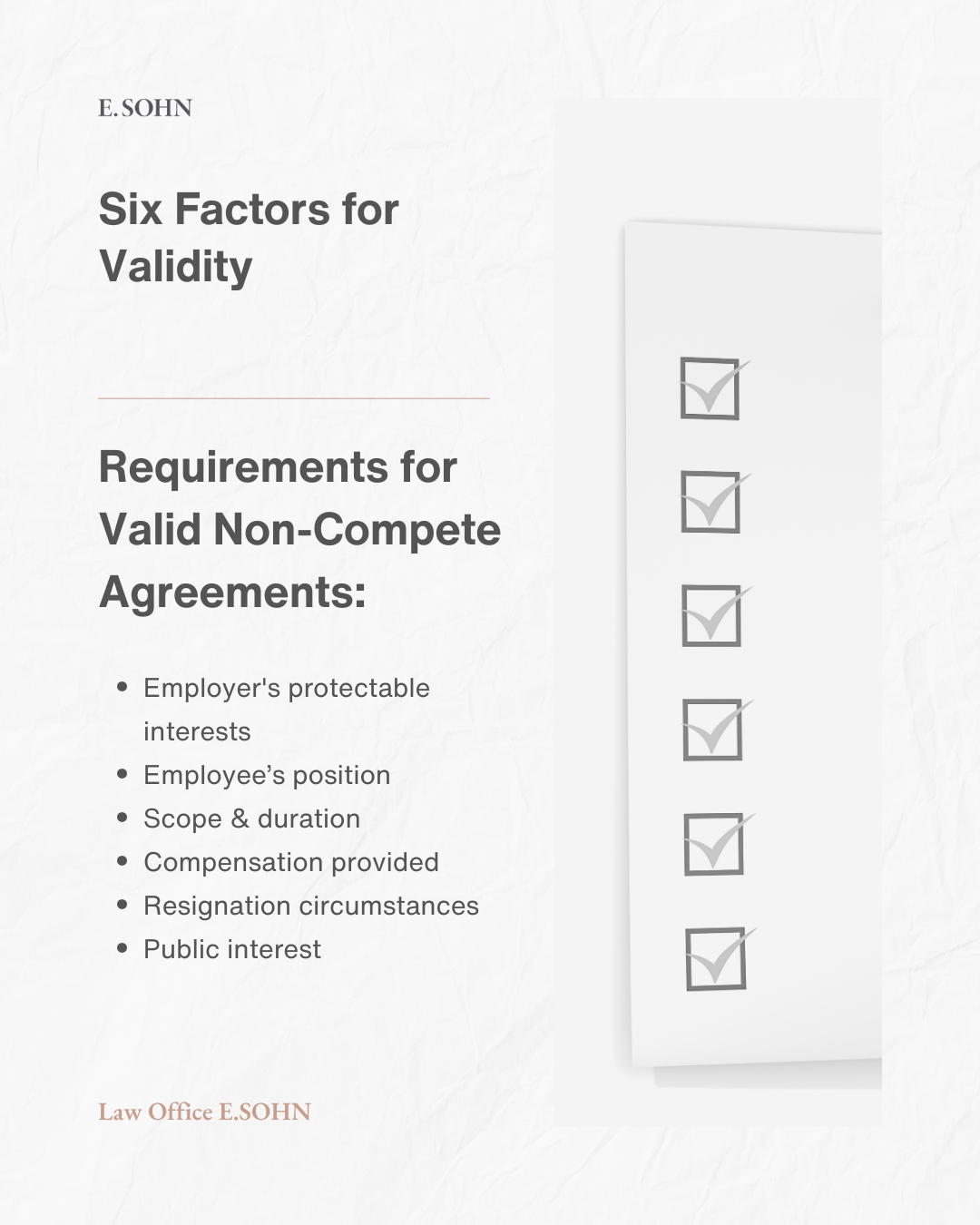
For a non-compete injunction to be granted, the non-compete agreement itself must be valid. The Supreme Court of Korea has established that non-compete agreements that excessively limit the freedom of occupation and labor are invalid. The court assesses the validity of such agreements by considering several factors: 1) the employer's interests, 2) the employee's position prior to leaving, 3) the scope, duration, and target industry of the non-compete restriction, 4) whether compensation was provided to the employee, 5) the circumstances of the employee's resignation, and 6) public interest and other relevant factors (Supreme Court Decision No. 2009Da82244, March 11, 2010).
1. Employer's Interests (Protectable Interests)
The Supreme Court recognizes that 'protectable interests' include trade secrets as defined by Article 2(2) of the Unfair Competition Prevention Act. Additionally, knowledge or information unique to the employer, which the employee agreed not to disclose to third parties, is also considered protectable.
In this case, the court noted that Company A, a global leader in the DRAM market, and Company C, which ranks third globally, were relevant to the evaluation. The court considered that the DRAM design work performed by Employee B was crucial to Company A.
2. Employee's Position Prior to Leaving
Employee B held a senior position at Company A for 24 years, handling DRAM design and possessing extensive knowledge of core technologies.
3. Scope and Duration of the Non-Compete Agreement
The non-compete agreement in question restricted employment with ten major competitors for a duration of two years.
4. Circumstances of Resignation
Employee B stated the intention to resign in order to spend more time with family. Company A had not demanded resignation or imposed any disadvantages, but instead tried to persuade B to stay by offering various conditions. The court noted that Company A did not force B to resign, which was a key consideration in the ruling.
5. Provision of Compensation
Although there was no direct compensation provided through the non-compete agreement, the court acknowledged the validity of the agreement based on overall circumstances. Company A had offered various incentives to discourage B's resignation and provided significant incentives and promotional opportunities while B was employed. These factors contributed positively to the court's decision to grant the injunction.
In summary, even if the non-compete agreement at the time of resignation was not present, the agreement and compensation received during employment, as well as favorable work opportunities, support the validity of the non-compete clause.
6. Public Interest and Other Considerations
Technologies such as DRAM design below 30 nanometers are designated as national core technologies by law. The court considered these factors and concluded that there was a public interest justifying the enforcement of the non-compete agreement.

If you need specific advice related to non-compete injunctions, please contact us via the phone number or email below. We are committed to providing thorough and dedicated consultation.

'Commercial' 카테고리의 다른 글
| EMPLOYMENT CONTRACT IN KOREA (0) | 2024.12.14 |
|---|
