
There are often inquiries about whether a judgment obtained from a foreign court can be enforced in Korea. If a foreign judgment does not have effect domestically, a new trial must be held in Korea. Let’s explore how to enforce a foreign judgment in Korea without the hassle of going through the same trial again.
"Can I collect my claim from the debtor's assets in Korea if the debtor resides there?"
A client residing in Uzbekistan had won a judgment against a debtor but was unable to recover the loaned money, making them an unpaid creditor. Although the judgment was finalized in Country A, the debtor had long been residing in Korea, with assets located in Korea, making it impossible to resolve the matter through enforcement in Uzbekistan. The client thus inquired whether it would be possible to collect the debtor’s assets in Korea based on the judgment from Uzbekistan. In response, our office provided the following guidance.

Once court approval is obtained for a foreign judgment, it gains enforceability in Korea.
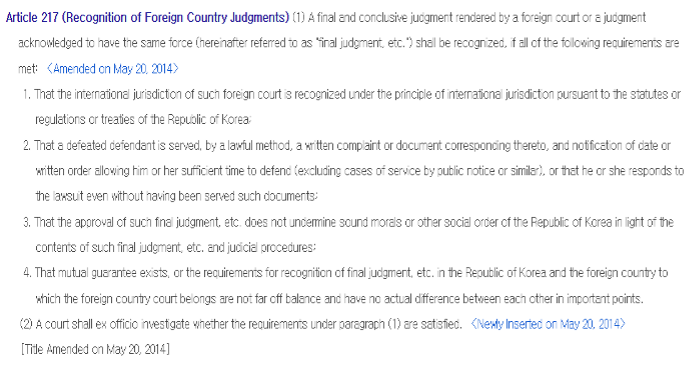
A foreign judgment, by itself, does not have enforceability in Korea. However, if a Korean court approves the foreign judgment, it then gains enforceability as if it were a domestic court judgment. This is outlined in Article 217 of the Civil Procedure Act.

Matters to Confirm in a Foreign Judgment
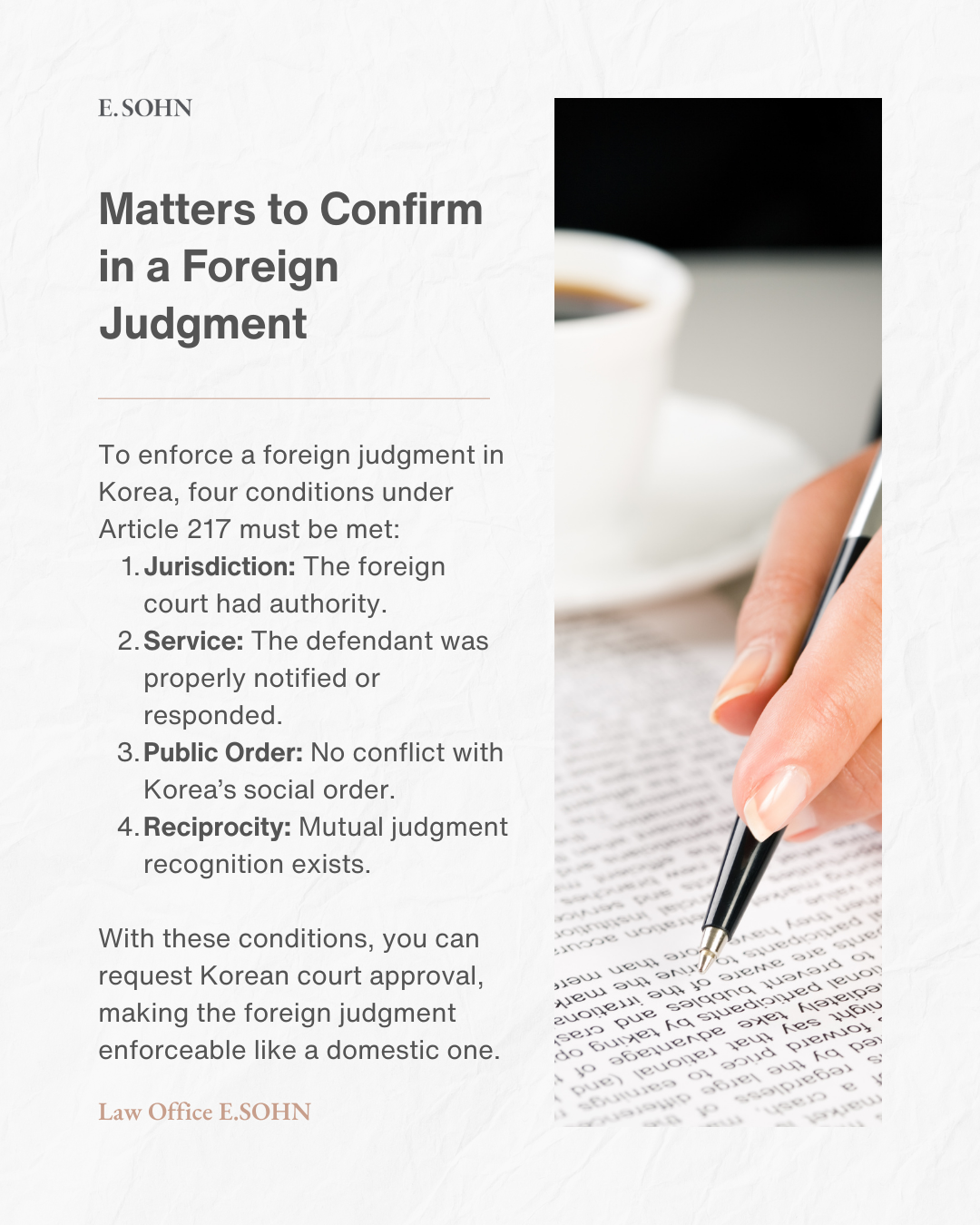
For a foreign court judgment to be approved by a Korean court, it must meet the requirements outlined in Article 217 of the Civil Procedure Act. In summary, these requirements are: 1) the foreign court must have proper jurisdiction, 2) the losing defendant must have received lawful service or responded to the lawsuit, 3) approving the foreign court’s judgment must not contravene Korea’s public morals or social order, and 4) there must be reciprocity.
If these four conditions are met, a petition for approval of the foreign judgment can be filed with a Korean civil court. Once approved, the foreign judgment will have the same enforceability as a Korean court judgment.
Documents Required for Approval of a Foreign Judgment
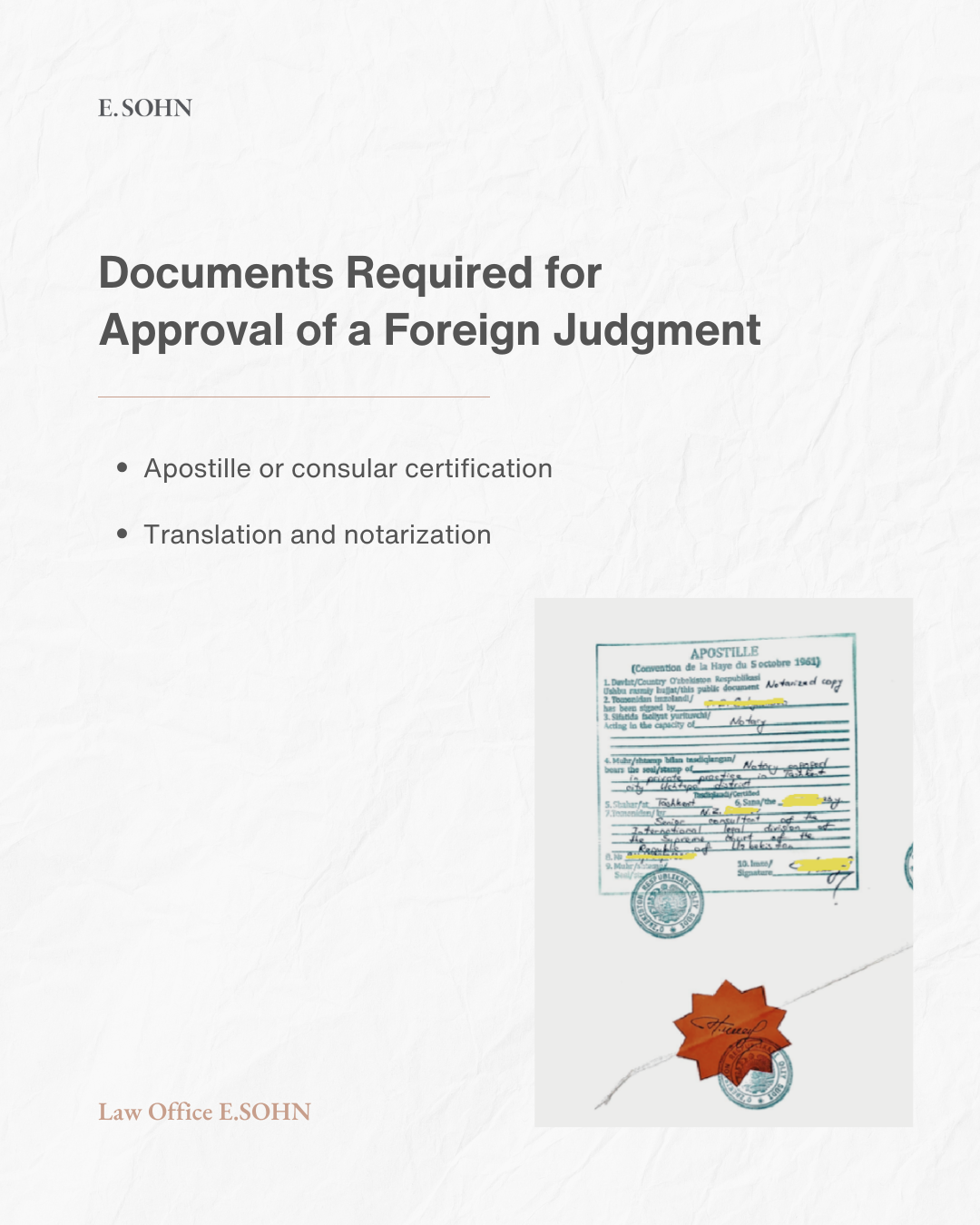
In cases involving the approval of a foreign judgment, documents are needed to verify the authenticity of the original judgment, in addition to the original judgment itself. First, an Apostille or consular certification is required. Since a foreign court judgment is not considered an official document domestically, an Apostille or consular certification from the Korean embassy (or consulate) in the relevant country is needed to grant it the same validity as a domestic official document. The Apostille is a certificate issued by the foreign country’s Ministry of Foreign Affairs. It is generally simpler than consular certification, so if Apostille is available, it should be obtained.
Second, a translation and notarization of the foreign court judgment are required. Since the judgment from a foreign court is in a foreign language, a Korean translation is naturally needed, along with notarization of the translation by a translator to ensure its authenticity.


E.SOHN has extensive experience providing advisory and litigation services for foreign individuals and corporations. If you have further questions regarding the domestic enforceability of foreign judgments, please feel free to contact us using the details below.

'Civil' 카테고리의 다른 글
| Understanding Korea's Jeonse System: A Guide for Foreign Residents (1) | 2024.10.25 |
|---|
